
Have you ever questioned your spending habits? Ultimately, the real reason we spend is to find a certain amount of happiness. I’m not talking about the fleeting happiness that comes from buying clothes or the latest electronic gadget, but rather true happiness, the kind that comes from what we believe the purchase brings us in terms of our core values and life goals.
By tracking our spending and exploring how it truly aligns with our values, we realize that having more stuff doesn’t always equal more happiness and often goes against our values.
The Modest Millionaires family believes that simplicity helps you better manage your money and then your efforts in order to better respect your values and live a life according to your true desires.
What am I looking for when I shop?
In the article How to Create a Realistic Budget by Tracking Your Spending , I describe the importance of tracking your spending and explain how I do it regularly. Not only is it the best way to see where your money is going and make a conscious choice to change your spending, but it’s also a great way to determine what you’re looking for in your purchases.
This idea is very well described in » Your Money or Your Life

So I highly recommend tracking your spending over the course of a month. Once you’ve listed your total expenses for a full month, take it a step further by asking yourself the following questions:
- What value or life goal does each expense, or expense category, align with?
- Are these truly the most important values to you?
- What are you looking to accomplish in your daily life, and in the long term?
- Sometimes certain actions that we do on a daily basis, although they may bring us some short-term happiness, are in contradiction with our long-term goals which could bring us a greater amount of happiness.
- What values can help you accomplish your goals?
 En faisant cette réflexion, vous serez en mesure de mieux aligner vos dépenses avec ce qui est important pour vous. Vous vous rendrez possiblement compte également que d’acheter ou d’avoir plus de choses n’est pas toujours synonyme d’avoir plus de bonheur et va souvent même à l’encontre de ses valeurs.
Cette réalisation dépend également d’un concept important provenant du livre ‘’Your money or your Life’’ de Vicki Robin et Joe Dominguez, soit du coût de vos achat en terme de votre temps, ou dans les termes du livre, de votre énergie vitale.
Le véritable coût de mes achats:
Lorsque l’on regarde nos dépenses, on pense normalement en terme de dollars. Il faut toutefois venir ajouter à ce montant le temps associé à ses dépenses. La première partie est, évidemment, le temps qu’il faut pour générer l’argent pour faire ses dépenses, ensuite le temps passé à magasiner l’achat puis tout autre temps de votre vie qui sera associé à ce que vous venez d’acheter pour que ce soit de l’entretenir, l’assembler ou simplement pour pouvoir en profiter.
Dans ‘’Your money or your Life’’ on en vient à calculer son réel salaire horaire, c’est-à-dire qu’on réduit son salaire par tous les coûts associés à faire son travail (vêtements expressément pour travailler, transport, etc.) et on divise se nouveau montant par ses heures de travail et également toutes les heures indirectements reliées au travail (transport, dîner, ventiler au retour). On peut ensuite traduire ce nouveau salaire horaire en terme de temps, appelé énergie vitale. Par exemple une personne qui arrive à un réel salaire horaire de 8$/heures doit dédiée 15 minutes de son énergie vitale à son travail pour chaque dépense de 2$.
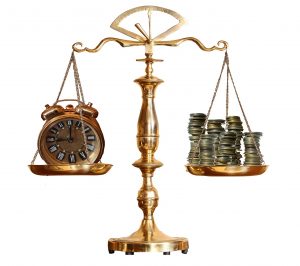 Une des étapes importante du livre est d’inscrire dans son tableau de suivi de dépense, le coût de chaque achat ou catégorie d’achats en terme de nombre d’heure d’énergie vitale, c’est-à-dire de diviser la dépense en dollars par notre réel salaire horaire pour avoir le nombre de temps qui doit être dédié au travail pour pouvoir faire cet achat. On demande ensuite de se poser les questions suivante:
- Est-ce que j’ai reçu une satisfaction et une valeur en proportion de l’énergie vitale dépensée?
- Est-ce que cette dépense d’énergie vitale est en accord avec mes valeurs de base et les objectifs de ma vie?
- Est-ce que ces dépenses changeraient si je n’avais pas à travailler pour vivre?
Ces questions et ce processus aident à mieux analyser ses habitudes de dépenses en fonction non seulement de ses valeurs et objectifs de vie, mais également en fonction de son temps. On en vient à prendre conscience du coût réel de nos achats.
Je crois ensuite qu’il est important de faire l’exercice de réfléchir à si chaque dépense engendre encore plus de dépenses à long terme en terme d’énergie vitale. Pour faire ceci posez-vous les questions suivantes:
- Combien de temps avez-vous pris pour faire l’achat (recherches, déplacement en magasin, etc.)?
- Does this purchase require additional time or expense to maintain, assemble, or enjoy the purchase?
- What is the approximate new cost in terms of vital energy of this purchase if we take into account this additional time linked to it?
A fairly significant example to better understand this process is that of buying a house. You will spend a lot of time to make this purchase and this is normal since the impact of this decision is very important. If you choose a larger house, it will have a high selling price but will also cost more to heat, since it requires heating a larger area and will also require a greater expenditure in terms of time to maintain it.
The true cost of a purchase can therefore turn out to be even more significant in terms of its vital energy and consequently in terms of the number of hours you will have to work to be able to pay all its additional expenses.
Simplicity as a solution:
For the Modest Millionaires family , the solution to this cycle of exponential spending is simplicity in terms of having less stuff, fewer recurring expenses, and fewer activities on the calendar to ultimately focus on the values and life goals that are truly important to us.
 Our priorities are primarily focused on spending time with family and friends, learning and pursuing our passions, and most importantly, having the freedom to spend our time as we see fit on the priorities listed above. These are priorities that can be met without having to spend a lot of money.
Indeed, by focusing on our values and life goals, we easily eliminate the desire to make purchases that would give us a small short-term pleasure but which would contradict our priorities. For example, it is easy for us to refuse to subscribe to cable since this additional expense would distance us from our financial independence which would offer us enormous freedom to devote our time as we see fit to what is important to us.
Having fewer activities on the calendar also falls into the same line of thinking. We have nothing against signing our children up for, say, a sports activity here and there, but we want to avoid having a dozen activities overlapping at the same time of year. This allows the whole family to decide to dedicate our time to the activities that really interest us at the time and avoids wasting precious life energy running from one activity to another according to a pre-established schedule.
Simplicity can therefore be practiced across all aspects of our lives in order to better align our spending in terms of money and time according to the values and priorities that are important to us.
On a final note, if you’re interested, Vicki Robin, who wrote « Your Money or Your Life, » was recently a guest on the Mad Fientist podcast (click here to listen) . It’s a great interview and definitely worth a listen (unfortunately, it’s only available in English).

